
Tires are one of the most important parts of a car, as they determine safety, comfort and performance on every trip. But how many drivers really know the tire lifespan in kilometers? Many of us use our tires longer than we should, which reduces grip and increases the risk of accidents.
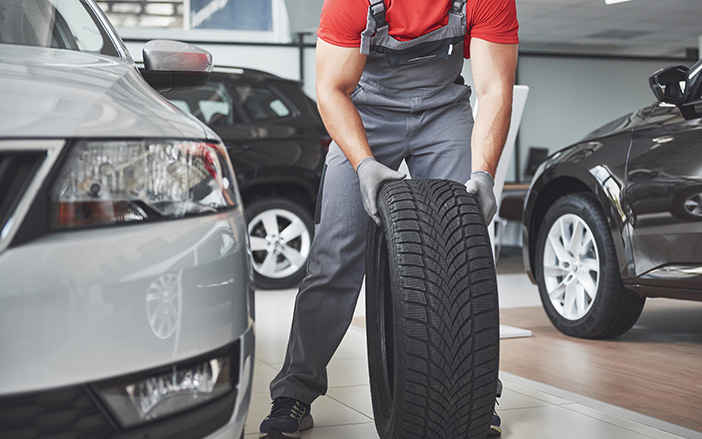
In this guide, you’ll discover how often to change tires on a car, how to check how fresh tires should be when you buy them, and of course what tires to choose for the best performance.
Tires are the only point of contact between your vehicle and the road. Even the most advanced car loses its value if its tires are worn. Cornering grip, braking distance, comfort and fuel efficiency depend directly on their condition.
That’s why it’s crucial to know not only how often to change tires on a car, but also how to maintain them properly to extend their lifespan.

The general recommendation is that tires last around 40,000 to 50,000 kilometers on average. Of course, this depends on many factors:
The type of roads you drive on (urban, highway, dirt).
Driving style.
Proper tire pressure.
Regular maintenance.
If you often drive long distances, the tire lifespan in kilometers decreases. If you use your car less frequently, tires may need replacement earlier due to aging rubber, even if the mileage is lower.
When buying new tires, it’s not enough to look only at the tread. Their age is equally important. So, how fresh should tires be?
Ideally, they should not be older than 12 months from the date of production. On the sidewall of each tire, you’ll find a four-digit DOT code indicating the week and year of manufacture. For example, 1022 means the tire was produced in the 10th week of 2022.

One of the most common questions is: how often to change tires on a car or how often should I replace tires on my car?
Experts recommend replacement every 4–5 years, even if you haven’t reached the mileage limit. Over time, rubber loses its elasticity and develops cracks, which dramatically reduces grip.
On the other hand, if you drive a lot, replacement may be needed earlier, once the tread wears below the 1.6 mm legal limit.
Even if you haven’t hit the mileage limit, there are clear signs that your tires may need changing:
Visible cracks or cuts.
Uneven tread wear.
Vibrations in the steering wheel.
Frequent loss of pressure.
If you notice any of these, it’s time to replace them.
Choosing new tires often brings the big question: what tires to choose? The answer depends on your needs:
For everyday city driving, all-season tires are usually enough.
For frequent highway trips, touring tires with comfort focus are ideal.
For mountainous or cold regions, winter or all-weather tires are best.
If fuel economy matters, look for tires with low rolling resistance.
The best way to decide is to check your car manufacturer’s manual and ask a professional.
Proper use can significantly extend the tire lifespan in kilometers. A few simple habits help:
Check tire pressure regularly.
Avoid harsh braking and aggressive driving.
Rotate tires every 10,000 km.
Ensure proper wheel alignment.
These steps not only extend tire life but also save money and keep you safer on the road.

Before starting a long journey, it’s important to know the condition of your tires. Let's Drive always prioritizes safety and maintenance. When you choose Car rental in Athens city center or Car rental at Thessaloniki airport, you can be sure the car you get is fully inspected, with tires in excellent condition.
For more details, check our guide: What do you need for car rental as a new driver?
With Let's Drive, you can always count on safe, reliable and well-maintained cars, so that every journey is a worry-free experience. Because good tires aren’t a luxury – they’re a necessity for safe driving.
